
For eleven hours this was the most straightforwardly fun game in the file. Two cooks in a narrow galley, orders arriving faster than is reasonable, and a physical model generous enough that a dropped pan is funny rather than costly.
Then the fourth region, and a change so specific that we stopped playing to talk about it. This review is mostly about that change, because it is the clearest example we have found of how a design decision manufactures resentment between two people who arrived friends.
The first three regions
Nearly perfect. The kitchen is cramped in a way that forces you into each other's path, which sounds annoying and is the entire joke: half the game is two people apologising while reaching for the same shelf.
Crucially, failure is local. Burn a pan and you have burnt a pan; the order goes out late, you lose a small amount of score, and the person responsible is obvious and unbothered because the cost is trivial. We failed constantly and laughed constantly, and those two facts are related.
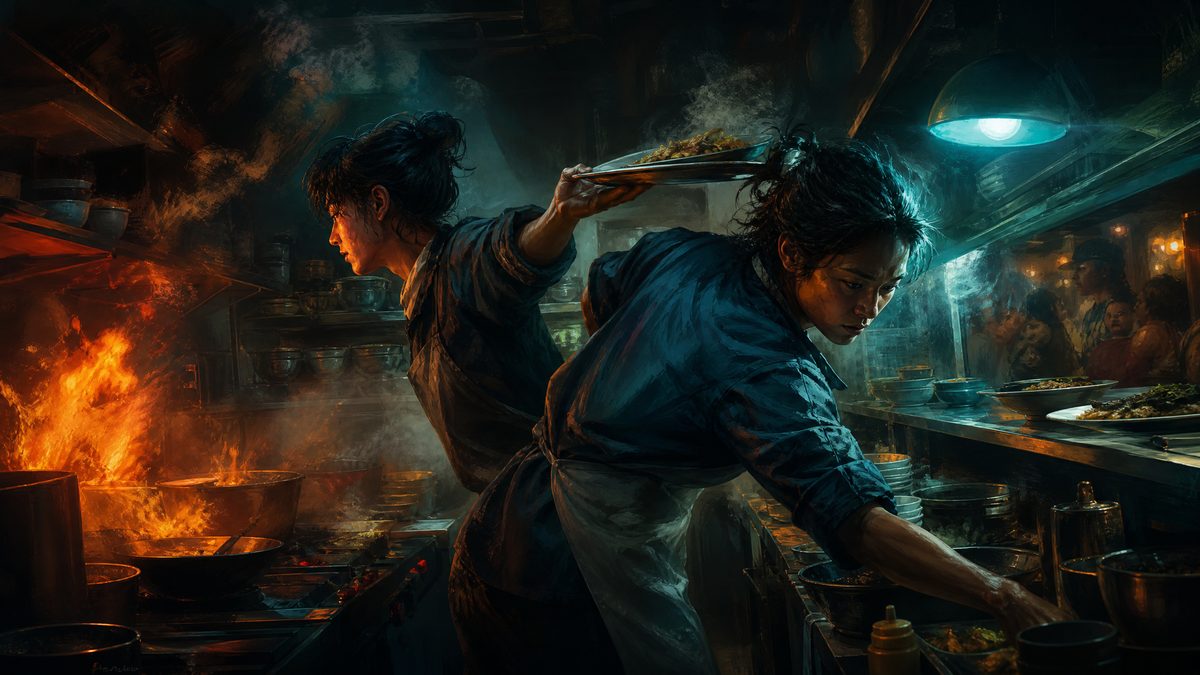
Region four, and the shared timer
The fourth region introduces a service clock that applies to the pair rather than the dish. Miss it and the entire service fails — not one order, the whole shift, including forty minutes of work that had gone perfectly.
This changes the arithmetic of every mistake. In region two a dropped pan cost a few points; in region four the same dropped pan can cost the shift, which means that for the first time it matters a great deal which of us dropped it.
We are not people who blame each other easily. Within two shifts we were saying things like you were on the grill, weren't you in a tone that was technically neutral, and both of us noticed.
A shared failure state with an individual cause is a machine for producing blame. The game did not intend it, and it does it every single time.
Why we kept playing for another six hours
Because the underlying game is very good, and because we found a workaround: we stopped dividing the kitchen by station and started dividing it by order. Each of us took whole dishes from start to finish, which reduces efficiency by perhaps a fifth and makes every failure unambiguously one person's own.
That fixed the friction and cost us the co-operation. Two people working in parallel in a shared space is not what this game was for, and by hour seventeen we were essentially playing single-player next to each other, which is where the partnership quietly ended.
| Region | Hours | Failure model | Sessions with friction |
|---|---|---|---|
| One | 3.0 | Per dish | 0 |
| Two | 4.0 | Per dish | 0 |
| Three | 4.0 | Per dish, tighter | 1 of 5 |
| Four | 3.5 | Shared service clock | 4 of 4 |
| Four, split method | 2.5 | Shared clock, parallel play | 0 of 3 |
The skill gap
Grade C, and the shared timer is why. In the first three regions a slower player costs the pair a little score and nobody minds. Under a shared clock a slower player is the reason the shift failed, and no amount of goodwill makes that invisible.
The game has no difficulty options that would help. There is no way to lengthen the service clock, no assist for a struggling player, and no per-player scoring that would let a mismatched pair enjoy the same shift.
What it gets right that most co-op games do not
Two things worth crediting. The kitchen is fully legible at a glance — you can always see what your partner is doing without asking, which is rare and makes the first three regions almost frictionless. And it is genuinely funny, which is the hardest thing on this list to design and the easiest to overlook.
The solo mode is also unusually good for a co-op game. Alone you run a smaller galley with one station fewer, which is a real adaptation rather than a concession, and 6.7 is an honest score for it.
Verdict
Together, 7.9. Eleven hours of the best comedy in the file, followed by a design change that reliably turns two friends into two people establishing who was at fault. Worth playing, and worth stopping at region four.
Alone, 6.7. A properly rebuilt smaller kitchen rather than the same game with a hole in it.
Two scores
Together 7.9 — excellent until a shared failure state arrives with individual causes.
Alone 6.7 — a genuine single-player adaptation, not an afterthought.