
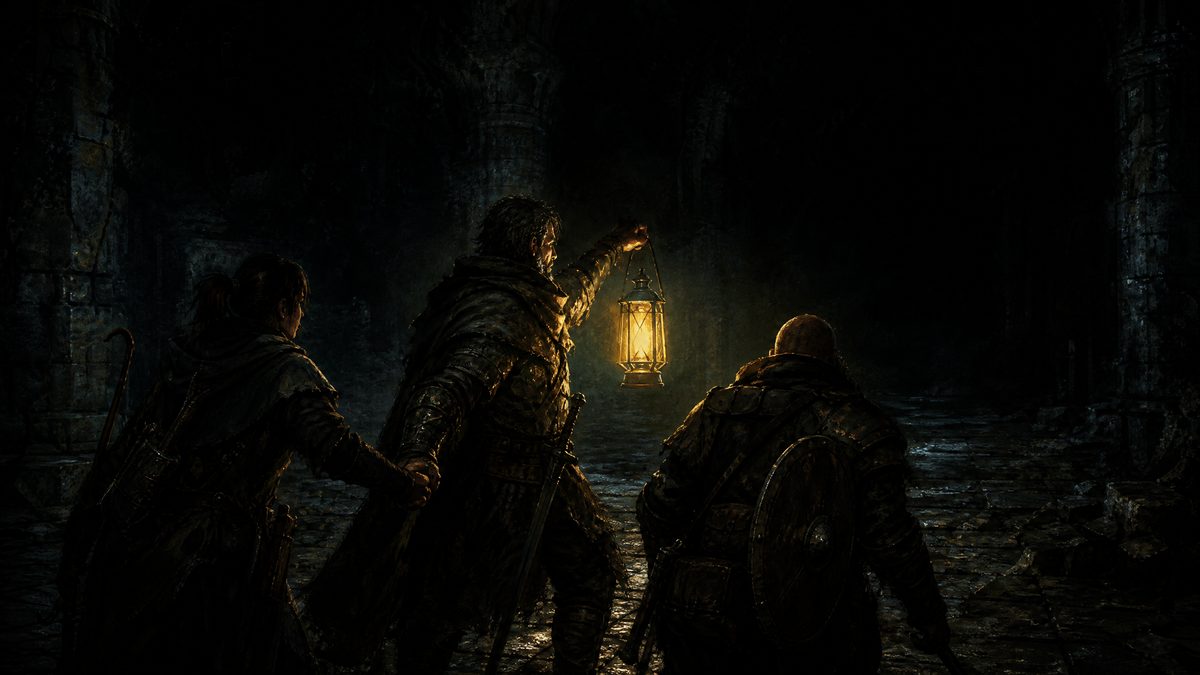
Three players enter a stone chamber. There is one lantern, it can be carried but not divided, and the darkness outside its radius is not dim — it is nothing, a black that the game renders as an absence rather than a shadow.
Everything that makes this game remarkable follows from that single object. There are no classes, no loadouts and almost no systems. There is a light, three people who need it, and twenty-one hours of finding out who you are.
The rule that does the work
The lantern's bearer cannot fight. Their hands are full, which means the moment danger appears the light has to be handed to someone, put down, or the group has to run — and every one of those choices is a negotiation that takes place in about two seconds.
We spent our first four hours being polite about this. By hour seven we had a system, by hour eleven the system had broken down under pressure, and by hour fifteen we had a better one built on the wreckage. That arc is the game.
Our argument, in detail, because it is the review
Hour nine, third region, a corridor with a collapsing floor. The correct play was for the bearer to go last, so the two ahead could see the ground. The bearer went first, because going first with the light feels safe and going last with the light feels like being left behind, and no amount of knowing the correct play makes the second option comfortable.
We lost the run. Then we had a genuine, slightly heated conversation about it, and what struck all three of us afterwards was that the game had produced this by giving us one object and taking away our eyes. There is no mechanic here that rewards conflict. There is only scarcity, and scarcity did the rest.
No system in this game punishes selfishness. It simply arranges the darkness so that being selfish is the most natural thing in the world, and then lets you watch yourself do it.
Why the skill gap is only grade B
Because the bearer role is much less demanding than the other two, and the group naturally hands the lantern to whoever is struggling. That is a humane outcome and it works, but it means a weaker player spends a great deal of the game holding a light and watching two better players do the interesting parts.
We rotated deliberately, which fixed it. A group that does not rotate will find the game quietly sorting itself into one carrier and two adventurers, and the carrier will stop enjoying it around hour eight.
| Region | Hours | Formation used | Outcome |
|---|---|---|---|
| One | 4.0 | Bearer front, ad hoc | Cleared, politely |
| Two | 5.5 | Bearer front, fixed roles | Cleared |
| Three | 3.0 | Bearer front — wrong | Failed twice, argument |
| Three, retry | 2.5 | Bearer rear, rotating | Cleared |
| Four | 6.0 | Bearer rear, rotating | Cleared, near-silent |
What it does with two players, and with four
Two is worse and four is worse, for opposite reasons. With two, the negotiation collapses into a simple alternation and the social pressure disappears. With four, the light's radius cannot cover everybody, so one player is always effectively absent and the game becomes about queuing.
Three is not a recommendation, it is a requirement. We would not buy this game without knowing two other people were committed to it.
Where it falls short
The fourth region introduces a second lantern, and it is a mistake. The entire tension of the game is scarcity of light, and the moment there are two lights the negotiation stops. We finished the region and understood why a designer might want to give players relief, but relief is the one thing this game should not offer.
There is also no way to play asynchronously. All three players must be present, which is realistic for the design and difficult for adults with jobs — our twenty-one hours took five weeks of scheduling, and that is the honest reason the partnership ended rather than any fault in the game.
Verdict
Together, 8.8. A game made of one object and total darkness, which produces more genuine social drama than anything else in this file. Requires exactly three people and their calendars.
Alone, no score. There is no solo mode, and a solo mode would be a different game with nothing left in it.
Two scores
Together 8.8 — scarcity as the only mechanic, and it is enough.
Alone — no score. No solo mode exists, and correctly so.