
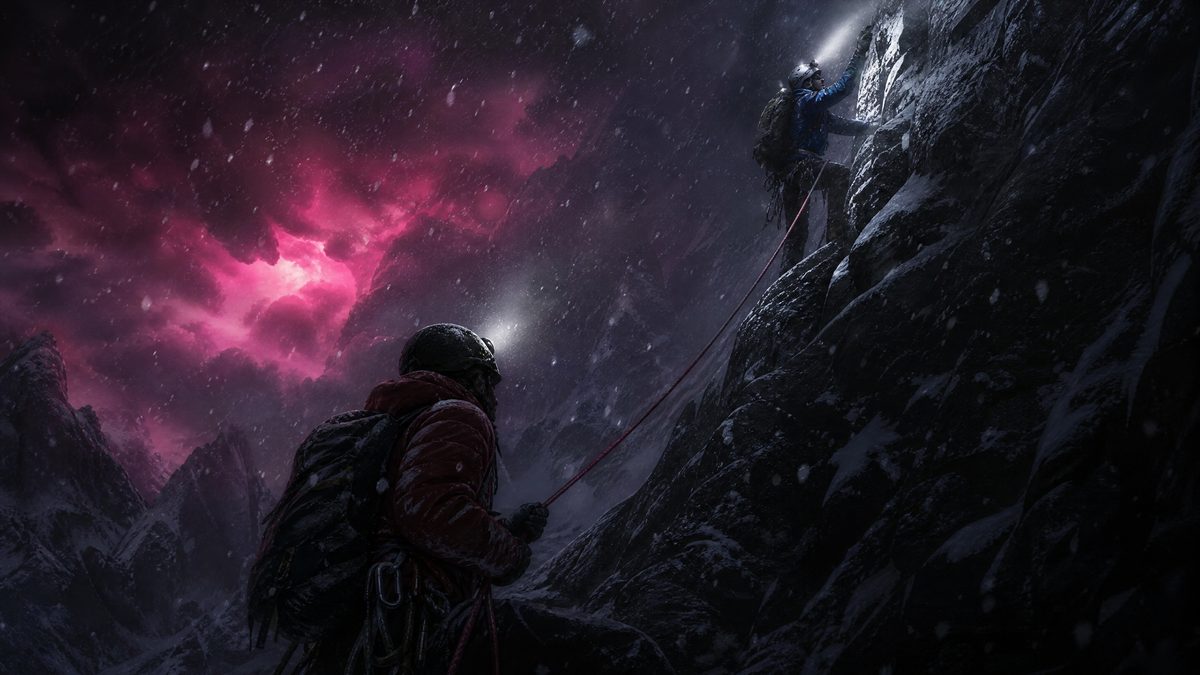
Two climbers, one rope, a black rock face and falling snow. Ridge Rescue is beautifully made — the best-looking and best-sounding game in this file, with a rope simulation detailed enough that we spent our first hour just belaying each other on flat ground to see how it behaved.
It scores 8.1 rather than higher because of something the review headline gives away: for the last third of our time with it, only one of us was really playing.
How the rope works, because it deserves the space
The rope is a physical object with length, slack and friction, and it connects two players who are usually on different parts of the same face. A leader climbs while a second belays, taking in slack and controlling what happens if the leader falls, and both jobs are real.
Falls are the game's finest achievement. A fall is not a failure state; it is an event with a length determined by how much slack was out, and surviving one intact and then continuing the pitch is the best feeling this file has to offer.
The gap, in order
Leading a pitch is difficult. It requires reading rock, managing stamina and placing protection under time pressure, and it takes real practice. Belaying requires attention and very little else.
One of us got good at leading. Not dramatically — perhaps twenty per cent more efficient — but the game's stamina system compounds small advantages, so a slightly better leader fails a pitch much less often, and failing a pitch costs both players ten minutes.
Nobody decided anything. By hour twenty it was simply obvious that runs went better one way round, and we drifted into it because we both wanted to finish the route. The last nine hours were one player leading every pitch and one player belaying every pitch, which is a legitimate way to climb a mountain and a poor way to spend an evening.
| Hours | Leader | Pitch failures per hour | Who suggested the split |
|---|---|---|---|
| 0 – 8 | Alternating | 2.4 | — |
| 8 – 14 | Alternating | 1.8 | — |
| 14 – 20 | Mostly one | 1.1 | Neither, it drifted |
| 20 – 29 | One, entirely | 0.6 | Neither |
Nobody proposed that one of us should stop leading. The game's own efficiency arithmetic proposed it, and we both agreed without noticing that we were agreeing.
What would have fixed it
Very little, which is the frustrating part. A route that required both players to lead alternate pitches would have solved it outright, and such routes exist in the real activity this game is modelling.
Or an assist for a struggling leader — slightly slower stamina drain, slightly more forgiving protection placement — available per player rather than per session. Several games in this file have per-player difficulty and it is the single most valuable feature a co-op game can have.
Instead the game has one difficulty setting for the pair, which means the better player either plays below their level or the weaker one drowns.
Why it still scores 8.1
Because for twenty hours it was superb, and because the belaying role, while easier, is not empty. Holding a fall correctly is genuinely tense, and there were several moments in the final nine hours where the belayer's attention was what saved the run.
It is also the only game here whose solo mode barely suffers. Alone you climb with an automated second, which sounds like a compromise and works well, because the belayer's job is exactly the kind of task a computer does reliably. A 7.8 solo against 8.1 together is the narrowest margin in the file, and that is a criticism disguised as a compliment.
Absence and return
Handled poorly, and we suspect for the same underlying reason. Return after a fortnight and your stamina and technique progression have not moved while your partner's have, so the returning player is now measurably worse at the game than when they left relative to the route ahead. Two of the nine games in the absence log do this and it is the least forgiving version of it.
Verdict
Together, 8.1. Technically the finest game in this file, with a rope simulation and a fall model nothing else here approaches, undone by asymmetric roles, one shared difficulty setting and an efficiency curve that quietly elects a leader.
Alone, 7.8. Almost as good, which for a co-operative game is the most damning number on this page.
Two scores
Together 8.1 — superb for twenty hours, then one player climbing and one watching.
Alone 7.8 — the narrowest gap in the file, and not to the game's credit.