
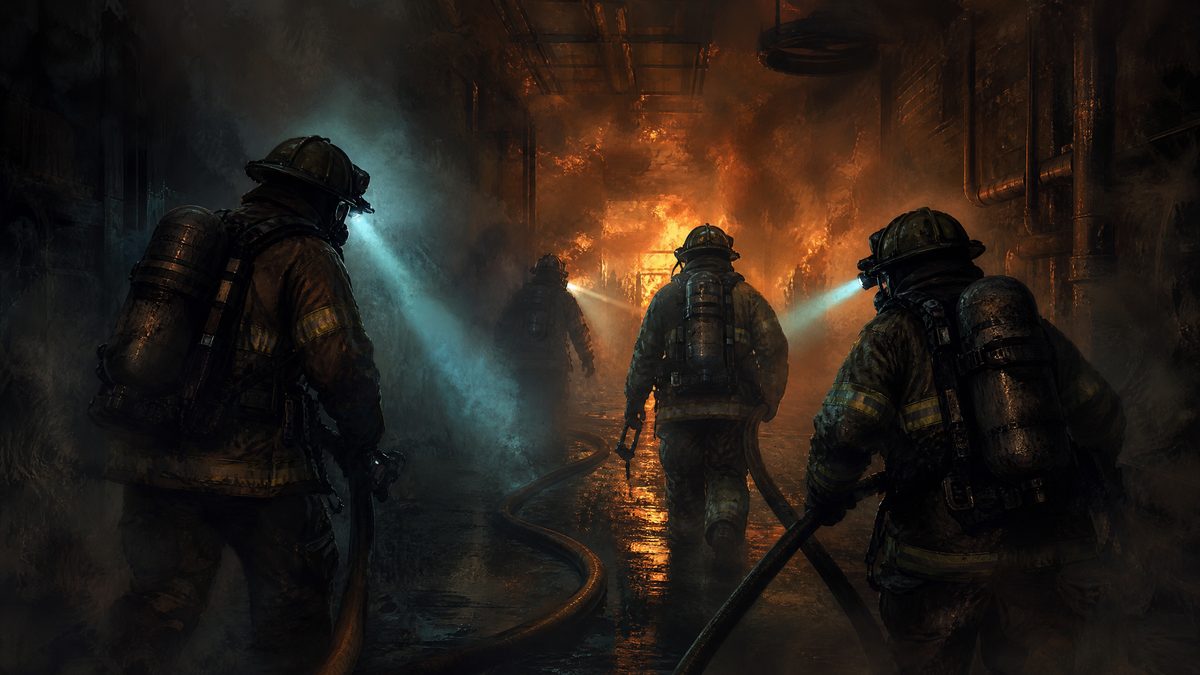
Everything physical in Smoke Order is excellent. Hoses have weight and pressure, doors behave differently depending on what is behind them, and smoke fills a space with enough conviction that we started using the same procedures a real crew would, not because the game told us to but because they worked.
Everything social in it is a mess, and the mess comes from one system: a friendly-fire model that assigns fault on contact rather than on cause.
What the game does properly
Four roles with genuinely different equipment. One player carries the line, one operates the pump and manages pressure, one clears and searches rooms, one holds the entry point and monitors air. None of these is a filler role and the third is the most interesting search mechanic in this file.
The building layouts are also unusually good. Every fire is a puzzle about airflow — open the wrong door and you feed the fire, so a large part of a successful shift is four people agreeing on a sequence before anybody touches anything.
The friendly-fire problem
Water in this game does damage. Hit a colleague with a pressurised line and they are knocked down and briefly incapacitated, which is a reasonable simulation and a reasonable penalty.
The problem is who gets penalised. The game logs the incident against the player who was hit as an incapacitation, and incapacitations count against the shift score. The player holding the hose — the one who swung it into their colleague — receives nothing at all.
The practical result is that the player doing the careful, stationary job of searching a room accumulates a poor record because a colleague keeps sweeping a line across them. Across our fourteen hours the searcher had eleven incapacitations logged and the line operator had none, and the line operator caused nine of the eleven.
| Role | Incapacitations logged | Incapacitations caused |
|---|---|---|
| Search and clear | 11 | 0 |
| Entry and air | 4 | 1 |
| Pump and pressure | 1 | 3 |
| Line | 0 | 12 |
The player who has been hit is recorded as the one who failed. Eleven times against the searcher, zero against the person holding the hose that hit them.
How that felt, which is the review
By hour eleven our searcher had stopped entering rooms ahead of the line. Not out of pique — out of correct play, because the scoreboard punished them for being where the water was. That made every fire slower, which made every fire harder, which made the whole group worse at the game.
The friction was never about the hits. It was about a scoreboard that told a truthful-looking lie four times an hour, and the fact that the only way to protect your own record was to stop doing your job.
Four players versus three
We played several shifts with three, and it is meaningfully worse. The air-monitoring role is the one that gets dropped, and without it the group loses track of time in a way the game does not warn about clearly enough.
The solo mode should not exist. Alone you command three automated colleagues through a menu, the fire simulation still works, and everything the game is about has been removed. A 4.8 is the lowest solo score in the file.
Where it could be fixed
Trivially, and that is why this review is annoyed rather than sad. Log the incident against the player who caused it. That is the whole fix. Every other criticism here — three-player balance, the weak solo mode, a slightly opaque air system — is a design trade-off. The blame model is a bookkeeping error with social consequences.
Verdict
Together, 7.6. Superb equipment, genuinely interesting fires, four roles worth having, and a scoring system that faults the wrong player often enough to change how the group plays. Fourteen hours, and we would return the day the log is corrected.
Alone, 4.8. A fire simulation with a command menu attached. Avoid.
Two scores
Together 7.6 — excellent physical design, undone by a scoreboard that blames the victim.
Alone 4.8 — the lowest solo score in the file and a waste of a good simulation.