
Most co-operative games solve communication by giving you a radio and hoping. Salvage Line solves it by making a submersible's lights, attitude and thruster wash into a vocabulary, then building tasks that cannot be completed unless both players learn to read it.
We came to this game after a run of four disappointments and expected another one. Thirty-four hours later it is the longest partnership in the file and the only entry where we finished the last mission and immediately started a second campaign.
What you actually do
You recover cargo from a black seabed. One submersible carries the lifting rig and the other carries the cutting arm, and neither can complete a recovery alone — not as an artificial restriction, but because the physics of a hanging load genuinely need a second vehicle to stabilise it.
Depth costs you light. Below a certain point the only illumination in the world is what you brought, which means your partner's floodlight is both a tool and a signal. Where they are pointing tells you what they think matters, and after a few hours you stop asking.
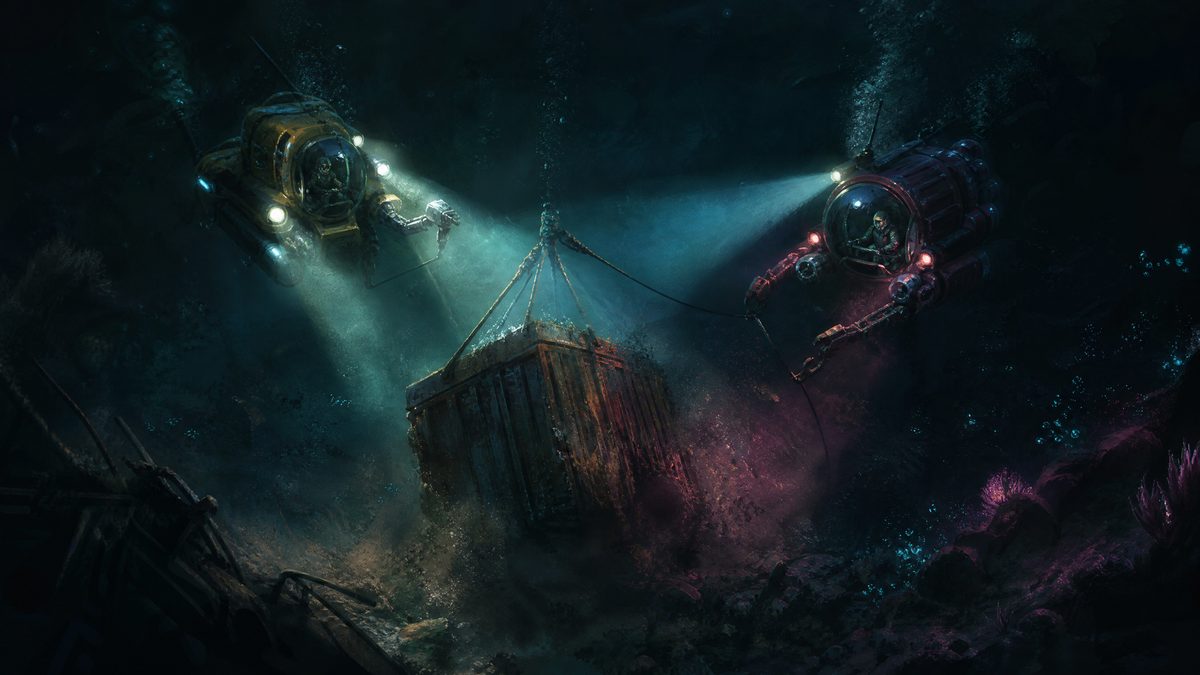
The moment it became a language
Hour six, on a recovery where the target had settled into silt. Silt is the game's cleverest hazard: disturb it and you blind yourself and your partner for perhaps forty seconds, so the two of you have to agree on an approach before anything moves.
We had no way of discussing an approach that the game recognised. What we had was the ability to point a light, and it turned out that a slow sweep along the intended path reads unambiguously as I am going in from here. By hour ten we had perhaps a dozen of these gestures, none of them taught by the game and all of them produced by its constraints.
By the end of the campaign we were running recoveries in near-total silence, and it was the least lonely a game has made either of us feel.
The skill gap, which is the important part
One of us is markedly better at vehicle handling than the other. In most games in this file that shows up within an hour and gradually turns one player into a passenger. Here it never surfaced, and the reason is structural rather than generous.
The two roles need different competences. Handling a lifting rig is about patience and reading strain; the cutting arm is about precision and timing. Being good at one predicts nothing about the other, so we ended up genuinely dependent on each other rather than politely pretending to be.
| Session | Hours | Who led | Notes |
|---|---|---|---|
| 1 – 3 | 6.5 | Alternating | Both roles tried; voice chat constant |
| 4 – 7 | 9.0 | Neither | Light signals emerging; voice dropping |
| 8 – 11 | 11.5 | Neither | Near-silent recoveries; deepest region |
| 12 – 14 | 7.0 | Neither | Campaign finished, second run begun |
Where it is weaker
The story around the salvage is thin and delivered through recovered documents nobody in either seat wanted to stop and read. We ignored it entirely by hour four and lost nothing.
There is also a difficulty cliff at the fourth region that cost us most of a session. The pressure mechanic changes without much warning and two recoveries in a row failed for reasons we could not diagnose, which in a less trusting partnership would have been the point where somebody blamed somebody.
And the solo mode exists, which is the kindest thing we can say about it. Alone you control both vehicles by switching, the light-reading vocabulary is meaningless because you already know what you intend, and a 9.2 becomes a 6.4. This is not a criticism — it is a game about two people, and it does not pretend otherwise.
Absence and return
Tested as part of the second session log. One of us stayed away for two weeks and returned to a save that had not progressed, because the campaign refuses to advance a mission without both pilots present. Some players will find that restrictive; we found it the most respectful handling of absence in the file.
Verdict
Together, 9.2. The best co-operative game in this file. A communication system that emerges from constraints rather than menus, two roles that need genuinely different skills, and thirty-four hours that ended because the campaign did.
Alone, 6.4. Functional, patient, and missing the entire point.
Two scores
Together 9.2 — silence as a feature, and a skill gap that never became visible.
Alone 6.4 — competent single-player salvage with the heart removed.