
The pitch is almost aggressively dull. You drive a goods train at night, in the rain, on a route with signals and speed restrictions and a paper order sheet that tells you which of them apply tonight. There is no combat, no failure state more dramatic than arriving late, and no music.
Twenty-six hours later it sits third in this file, and the reason is a mechanic so simple it barely qualifies: the driver cannot read the order sheet.
Two seats, two kinds of blindness
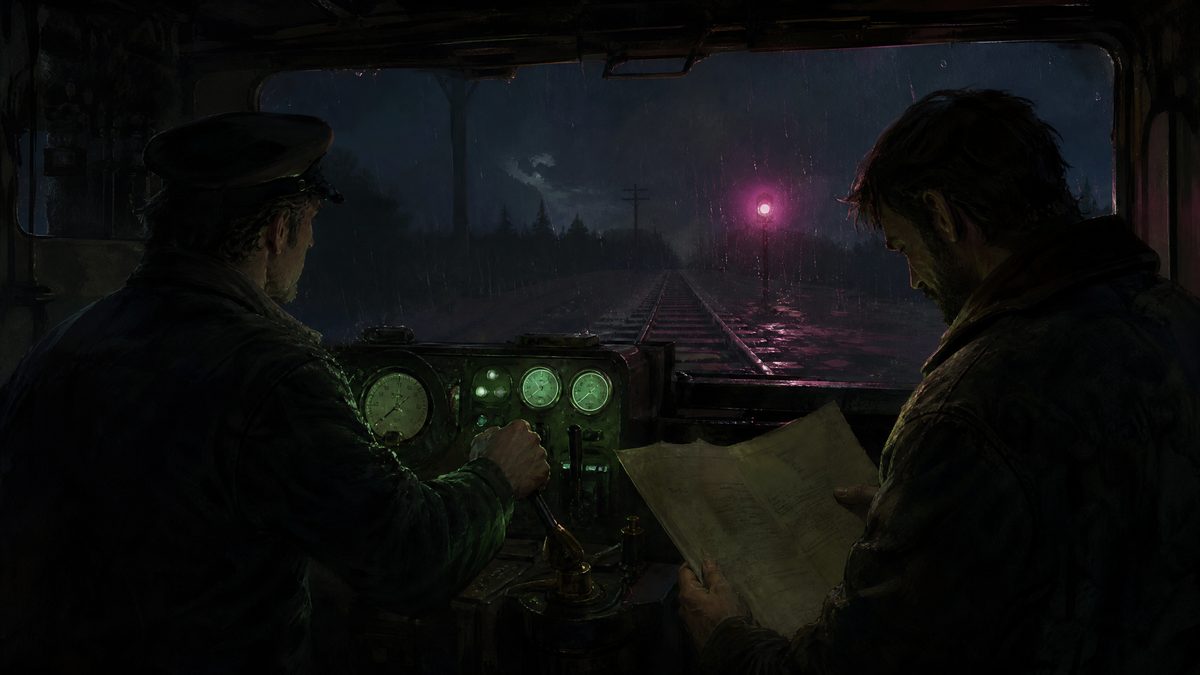
The driver has the controls, the forward window and the instruments. The conductor has the orders, the route timetable and the radio, and their view of the track is a small side window that shows mostly rain.
Neither of you can do the other's job, and crucially neither of you can even see the other's information. The conductor knows there is a temporary speed restriction at a certain marker; the driver knows what speed they are currently doing and where the marker is. Getting a train safely through a restriction requires those two facts to meet in the middle at the right moment, out loud.
What twenty-six hours of talking does
It builds a shorthand, and watching that happen is the pleasure of the game. Our first run was full of complete sentences. By the fifth we had a call-and-response rhythm — a number, a confirmation, a distance — that would be unintelligible to anyone else and is more or less how real crews work.
The game never teaches this. It has no communication tools at all beyond the fact that both of you are in the same room, and the shorthand appears because reading a full sentence takes too long at fifty miles an hour.
There is no communication system in this game. There are two people who each hold half of what is needed, and a train that will not wait for them to work it out.
Where the skill gap sits
Driving is harder than conducting, but conducting is more stressful, and those two facts happen to balance. The weaker driver in our pair spent the middle of the campaign conducting, which sounds like relegation and is not — an inattentive conductor derails a run just as reliably as a heavy-handed driver.
It earns a B rather than an A because the conductor's job has a ceiling. Once you know the route, reading orders becomes routine in a way that driving never does, so on the last few runs we swapped constantly to keep the passenger seat interesting.
| Run | Hours | Words per minute, roughly | Late arrivals |
|---|---|---|---|
| 1 – 2 | 4.0 | High — full sentences | 4 of 4 |
| 3 – 5 | 6.5 | Falling — shorthand forming | 3 of 6 |
| 6 – 9 | 8.0 | Low — numbers only | 1 of 8 |
| 10 – 12 | 7.5 | Low, with silences | 0 of 6 |
The night route, and why it matters
Almost the entire campaign takes place after dark in poor weather, which is a design decision rather than an aesthetic one. Daylight would let the driver read the world directly and the conductor would become decorative. Rain, darkness and a windscreen that streaks are what force the two of you to pool information.
It is also genuinely atmospheric. The cab is warm and green-lit, the world outside is black, and after twenty hours we both found the sound of the rain on the roof more relaxing than most games designed to relax you.
Where it falls short
The solo mode gives you both roles and pauses time when you open the order sheet, which is a sensible accommodation and removes the game entirely. A 5.1 is generous.
The campaign is also short — twelve runs, of which the last three are variations. We reached the end at twenty-two hours and spent the final four repeating our favourite route, which is a pleasant way to run out of game but it is running out of game.
And there is nothing to do about a partner who does not want to talk. This is the only game in this file that is completely unplayable in silence, which is worth knowing before two quiet people buy it.
Verdict
Together, 8.4. A co-operative game made from asymmetric blindness and speech, with no systems layered on top. Third in the file and the one we recommend most often, because almost nobody expects to enjoy it.
Alone, 5.1. Both jobs, no urgency, no conversation, and a pause button where the tension used to be.
Two scores
Together 8.4 — asymmetric information and a shorthand you build yourselves.
Alone 5.1 — competent train driving with the second seat removed and time paused.